Industrial automation
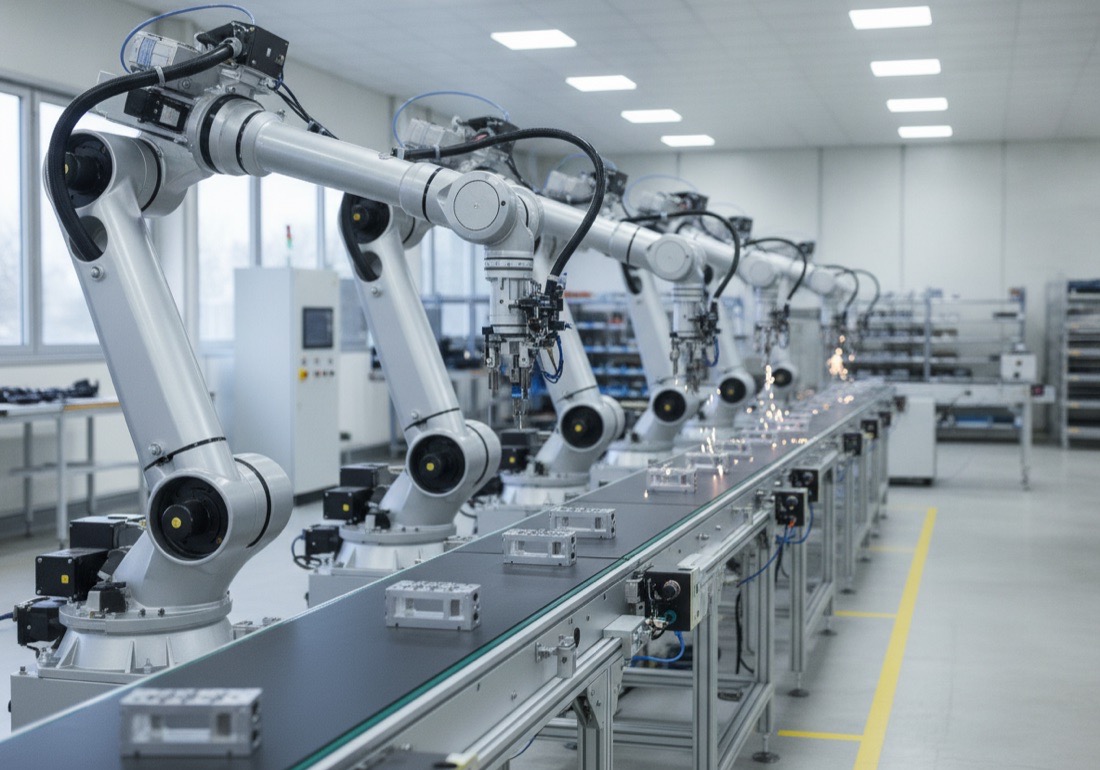
Industrial automation bundles everything that makes manufacturing self-controlling: robotics, sensors, programmable logic controllers (PLCs), machine vision and the networking of machines under the heading of Industrie 4.0. We approach this deliberately "from the theme first" — you understand the forces behind an entire industry before you look at any single stock.
Why this theme matters in the DACH region
Germany, Austria and Switzerland share an unusually broad and deep industrial base. A large share of value creation comes not from the well-known corporations but from the Mittelstand — often specialised, family-owned companies that hold world-market shares in a narrow niche. That is exactly where much industrial automation sits: suppliers of control technology, makers of precision sensors, providers of drive systems or machine-vision solutions.
These companies are strongly export-oriented. Their components go into machines and plants sold worldwide. That makes the region a natural place to study the theme — but it also means demand is tied less to the local business cycle than to global investment decisions. Anyone trying to understand small caps from this space therefore has to look well beyond the DACH region.
What drives the theme
Behind automation sit long-term, structural forces — not a short-lived fashion. Four are named again and again:
- Labour shortages and demographics. Where skilled workers are scarce and workforces are ageing, automating routine tasks becomes a necessity rather than a luxury.
- Reshoring and more resilient supply chains. When companies move production back or closer to their markets, higher labour costs are often only bearable with a higher degree of automation.
- Efficiency and quality pressure. Sensors and machine vision reduce scrap, lower unit costs and make processes measurable — a durable argument, independent of the cycle.
- Digitalisation of the factory. Networked machines produce data used for maintenance, planning and control. That shifts value creation towards software and service.
These drivers explain why the theme stays relevant over the long run. They say nothing, however, about whether a particular company turns them into a durable advantage — that is a separate, empirical question.
What to look at when you analyse
When you examine companies within this theme, a few theme-specific markers are worth checking:
- Export share and regional spread. How much revenue depends on single countries or regions? A high export share is both an opportunity and a concentration risk.
- Dependence on the investment cycle. Automation sells when customers invest in new equipment. When those customers' capex cycle winds down, demand often falls with it.
- Order backlog and book-to-bill. Order intake is an important leading indicator here. A shrinking backlog can show up long before revenue does.
- Margins and the share of service/software. Recurring revenue from maintenance, spare parts or software stabilises margins and softens the cyclicality.
These questions are part of a systematic analysis. How to work through them in a structured way is shown in the 6-step process , and the matching tools are in the Toolkit .
Risks & pitfalls
As attractive as the long-term drivers look, the typical pitfalls are just as clear:
- Cyclicality. Demand swings with the investment budgets of industry. A strong year says little about the ones that follow.
- Customer concentration. Many niche suppliers depend on a few large buyers or a single end-industry. If a major customer drops out, earnings are hit hard.
- Competition from Asia. In standardised components, price pressure from Asian suppliers is growing. The edge then lies in specialisation, quality and service — or it erodes.
- Thematic overvaluation. When a theme is in fashion, the price can run ahead of the substance. A good story is not a valuation.